
Reselling Square POS starts with two things: knowing the product inside and out and knowing how to tell a business how it is going to help them win. When you get to this point, this POS and its countless benefits will sell itself. Not to mention the benefits it will provide you as an agent or part of an ISO.
Now the first question you must be asking yourself is, ‘Where do I get started?‘ Fortunately for you, you came to the right place.
To resell Square POS, you sell under a partner that already holds the Square relationship, like Turnkey. As a Square partner, we support ISOs and agents by taking deployment off their plates: building their merchants’ menus, training staff on the system, being there on go-live day, and supporting the merchants from then on. With Turnkey, that part is on us. What’s left for you is getting in front of merchants and starting the conversation about why Square is the best fit for their business. That’s why we made this guide for you.
New to reselling Square?
This guide is for hungry sales reps on the ground, looking for the businesses that need Square today. If you’re not a Square reseller yet, start with our Square Reseller Application, where you’ll find our Square ISO & agent program tiers.
Still not convinced? Check out our guide on how to become a Square reseller, where it covers the program details and why Square has the best reseller program to assure you that selling this POS is an absolute good use of your time.
Here's The First Things You Need To Know Before Selling Square
Here are the top three benefits that make Square easy for you to sell. The first is the range of merchant types you can sell Square to. The second is that transitioning and onboarding a merchant to Square can’t get any easier. The third is everything Square gives a merchant beyond the register, making it a one-stop shop for what a merchant actually needs. These benefits are what keep your merchants from ever wanting to move away from Square, and most importantly, from you.
1. The Types of Merchants Square Is Best For
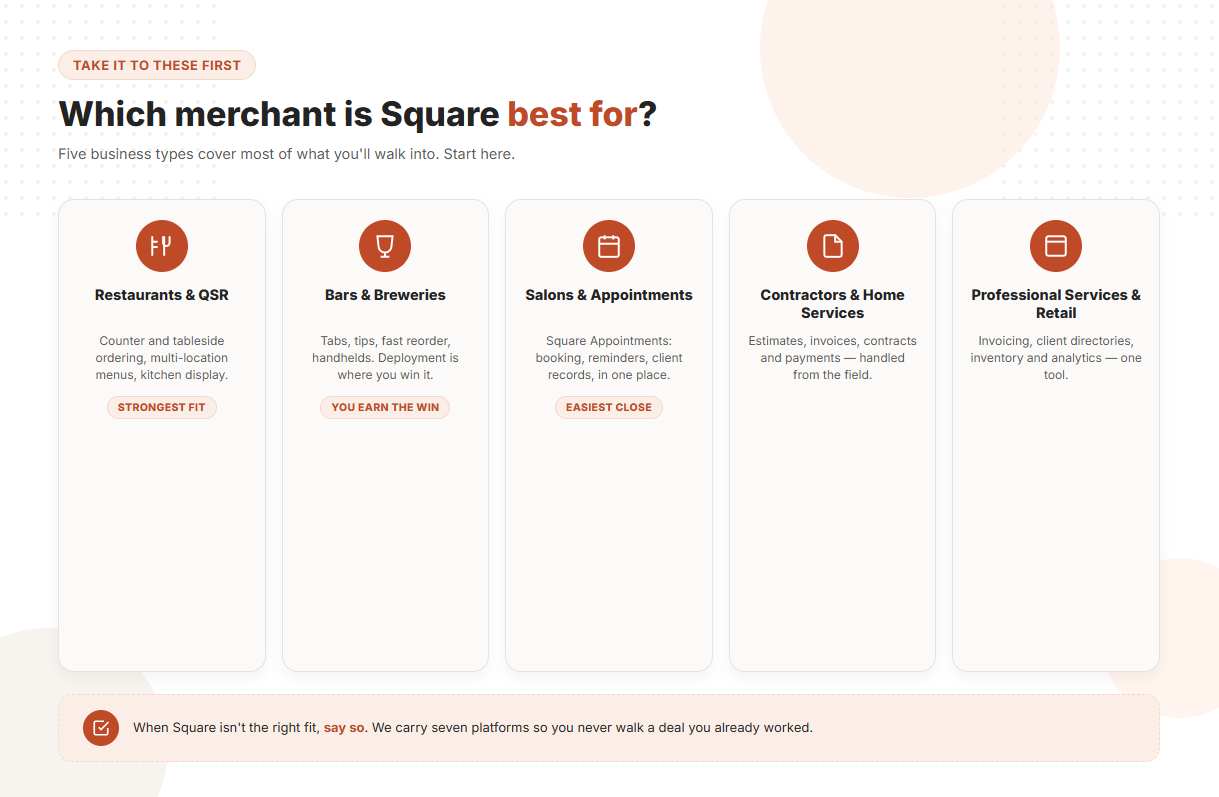
You can sell Square to almost any merchant, but some get a lot more out of the POS than others. Start with these five. Each merchant uses a different part of Square, so what you lead with depends on who you’re talking to. If you want to brush up on the product before a meeting, Square POS covers each of them by business type.
- Full-service restaurants, quick service, and fast casual. Counter and tableside ordering, menu management across locations, kitchen display workflows. The strongest fit and the highest deal value on the list.
- Bars and breweries. Tab and tip workflows, fast reorder, handhelds. Complex enough that the deployment matters, which is where you win it.
- Salons, barbershops, med spas and appointment businesses. Square Appointments handles booking, reminders, and client records in one place. The easiest close on this list for a brand-new agent.
- Contractors and home services. Estimates, invoices, contracts, and payment tracking, all handled from the field rather than back at an office.
- Professional services and retail. Invoicing, customer directories, inventory, and analytics without stitching four tools together.
Though we believe Square is ideal for almost every merchant, when a business doesn’t think it’s the best POS for them, we carry seven POS platforms precisely so you always have a solution for any business you connect with. SkyTab and the rest are there for exactly that reason.
2. Onboarding Merchants With Square Can't Be Any Easier
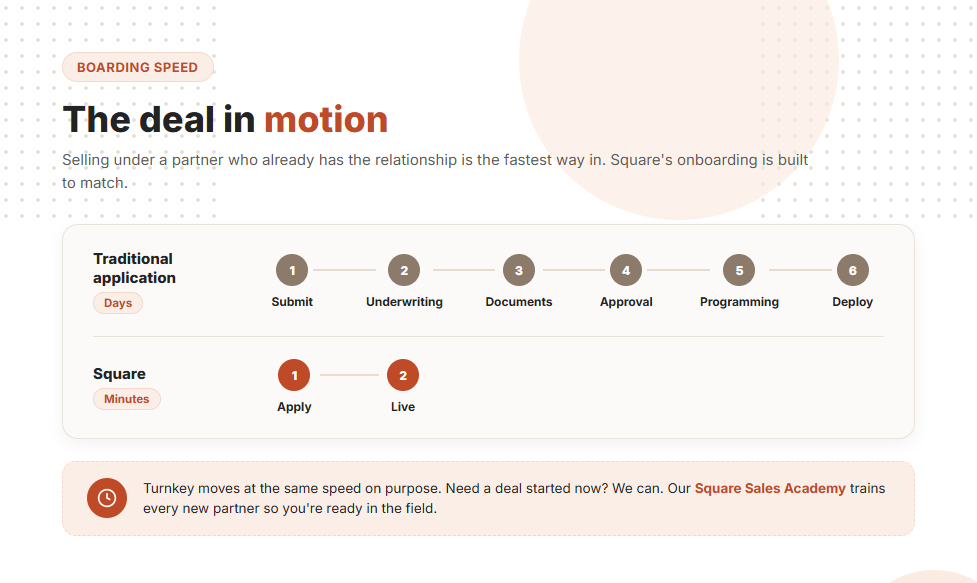
Every hour you spend chasing paperwork is an hour you’re not in front of your next merchant. Square is built to get out of your way on both ends: the signup and the setup.
That means you close today, not next week. You don’t need a complete file to get the merchant signed and moving on Square. Enroll them with what they have in hand, and spend your next conversation getting them live instead of chasing them to find their EIN or bank account number. That’s one less sales meeting you need on your calendar and one less deal sitting half-closed while you wait on a document.
Deployment moves just as fast. Tools like FlowAI move a merchant’s existing menu onto Square without you rebuilding it item by item, and that same ease carries through installation and staff training. Less time spent on setup means less downtime for the merchant between saying yes and taking their first transaction, and a shorter runway than merchants are used to with other POS systems.
The result: fewer stalls, faster closes. Taking a merchant from a POS nightmare to a rollout this easy is what gets you to a “yes” faster than you’ve ever gotten one before.
What this buys you is time: less of it spent on another meeting, paperwork, and setup, and more of it spent finding the next merchant account that’s waiting for you. And what it buys the merchant is what they actually want, an easy and quick process to get Square up and running and start taking transactions right away.
3. Square Offers More Than POS
Square isn’t just what’s on the counter. It’s the account behind the merchant’s entire operation, which means every conversation you have after the sale is another chance to grow the account and grow your residual.
- Team management keeps a merchant’s staff, not just their POS. Scheduling, payroll, benefits and team communication all run through one login instead of four separate vendors and four separate points of contact. For a restaurant, that’s not a convenience, it’s retention: staff paid through Cash App get their money the moment their shift ends, even on a Saturday night, and merchants who offer that keep their crew longer in an industry that loses most of its staff every year. You get to be the one who fixed their turnover problem, not just their card reader.
- Banking means a merchant’s money works on their schedule, not their bank’s. Funds from a sale are available in the account the moment it happens, seven days a week, holidays included, so a merchant is never waiting on a bank that’s closed for the weekend to make payroll or pay a vendor. That same access lets them pay a staff member on the spot instead of telling them to wait until Friday. A merchant who’s never stuck without cash on hand is a merchant who never has a reason to look at another processor.
- APIs and SDKs are what let Square grow with a merchant instead of getting outgrown. A single-location shop will never touch these, but a multi-location operation or a merchant building their own app needs a system that scales into their business rather than boxing them into someone else’s software. When that merchant expands to a second or third location, Square is already built for it, and so are you.
- The app marketplace keeps a merchant connected to everything they already run. Accounting, marketing, loyalty, delivery, none of it has to be replaced to work with Square. A merchant can keep their customers coming back and stay visible to them without adding another tool to manage, and every one of those connections is one more reason the account never leaves.
Every one of these is a reason to come back to a merchant after the sale, not just close it and move on. Small shop or growing multi-location account, you meet them wherever they are, with the tool that matches what they need right then, and every product they add is one more reason they stay with Square, and stay with you.
The Discovery Questions That Qualify a Square Deal
Open on the business’s workflow and operations, not the rate they are spending on their current POS. A workflow conversation shows the merchant what Square does for their business, and that’s where Square wins.
Start here: “Walk me through a typical transaction, from the customer walking in to the money hitting your account.”
Let the merchant talk. Their answer will show you where their current system slows them down. Then follow up with the questions that fit the business:
- How long does it take you to close out and reconcile at the end of the night?
- When did you last change your menu, and who did it?
- How do orders from delivery apps reach your kitchen right now?
- How fast do you get your money, and has that ever been a problem?
- What are you paying for the software, on top of processing?
- If you could change one thing about how you take payments, what would it be?
This shows the merchant you aren’t trying to sell them something. It shows them you care about the success of their business, and that you’re taking the time to understand who they are and the kind of business they run before you say a word about Square. That’s how you earn their trust and become their guide to what winning looks like for their business next. From there, Square sells itself, and you’re the professional who gets them to their goals.
The Delivery Question Every Restaurant Asks
Square sends delivery orders straight from DoorDash, Uber Eats, and Grubhub into the POS, so nobody re-keys anything. DoorDash and Grubhub connect directly through the Square Dashboard. A restaurant using several delivery apps can add an integration from the Square App Marketplace that pulls every app into one feed and prints each order as a kitchen ticket. Either way, delivery orders reach the kitchen the same way dine-in orders do, keeping the kitchen running smoothly and taking extra work away from front-of-house staff.
Objections You Will Hear, and How to Handle Them
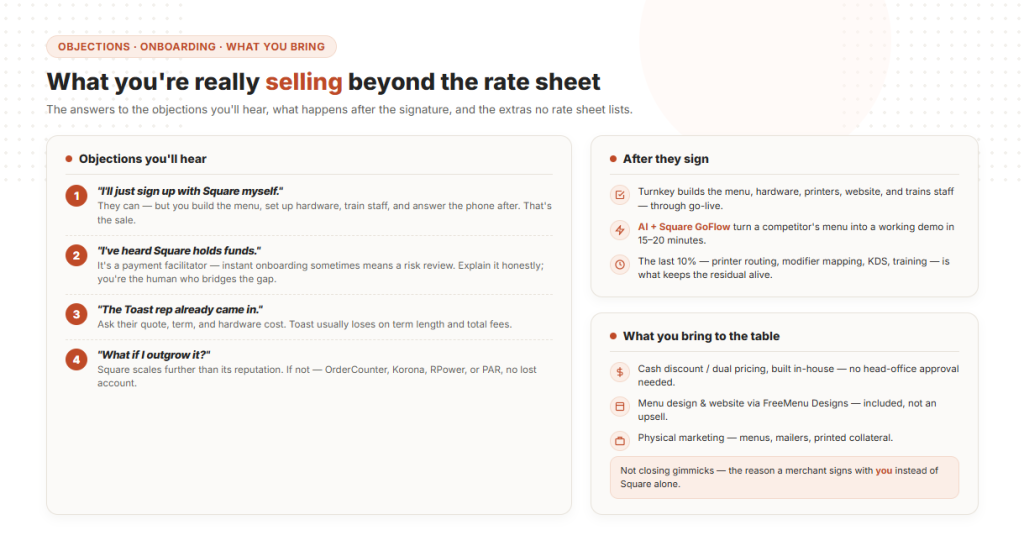
“I’ll just sign up with Square directly.” What they get from you is somebody who builds the menu, configures the hardware, routes the printers, supports the staff, and is there on go-live day, plus a local rep who answers the phone afterward. That means their system works from the first order, their staff knows how to use it, and when a question comes up, they call someone who already knows their setup. They can sign up online, and the software is free. But online, they get an account and a box of hardware, and the rest is on them. The software is not what they are buying from you. The implementation is.
“I’ve heard Square holds funds.” Tell them the truth: it can happen. Square is a payment facilitator. It approves merchants quickly and reviews activity afterward, and unusual volume, such as a sale far larger than the merchant’s normal ticket, can trigger a risk review. Walk them through what normal looks like for their business so a review never catches them off guard. A merchant who signs up online finds this out when it happens. A merchant who signs up with you hears it up front and has a real person to call to bridge any service gaps. That is the value you bring as the rep.
“The Toast rep has already been in.” Ask what they were quoted, how long the contract runs, and what the hardware costs up front. Then ask the workflow questions above. Toast wins some of these deals on merit, and when it is the better fit, say so. Where it does not, it usually loses on contract length, total software fees, and upfront hardware commitment. With you, the merchant gets Square’s pricing and the in-person setup we deliver.
“What if I outgrow it?” Square handles more than many owners expect, including multiple locations, kitchen displays, and online ordering. Where it genuinely does not fit anymore, a merchant who went direct starts over with a new company. Your merchant does not. Turnkey carries six other systems, so you can move them without losing the account: Clover for hardware options, SkyTab for full-service restaurants, OrderCounter for fine dining and complex coursing, Korona for high-transaction retail, RPower for bars and multi-concept groups, and PAR when a group has outgrown single-location software altogether.
What Happens After They Sign
This is the part that determines whether the residual you just earned is still there in three years.
Step 1: The menu gets built, fast. Turnkey uses AI to turn a merchant’s existing menu into a programmed Square build. Square’s own GoFlow will pull an entire menu off a competitor’s site, including a Toast site, and turn it into a working demo, or something installable, inside fifteen to twenty minutes. On the road, that’s a demo you can build sitting in front of the merchant. On install day, it gets you about ninety percent of the way there.
Step 2: Turnkey handles the rest, in person. The last ten percent is physical: printer routing, modifier mapping, KDS configuration, staff training, and go-live coverage. Turnkey also configures the hardware and sets up the website. This part is ours, not yours or the merchant’s.
Step 3: The merchant stays, and so does your residual. A system that works on day one, with staff who were actually trained on it and someone who showed up for go-live, is a system a merchant doesn’t go looking to replace. That’s what keeps them on Square long enough for your residual to be worth having.
What You Can Put on the Table That Square Deals Can't
Three things you can walk in with that a competing rep cannot.
- Cash discounting, built in-house. You can offer 4% or 5% cash discount pricing on the spot instead of checking with head office first. For a merchant tired of losing a cut of every card sale, that answer in the first meeting can decide the deal.
- Menu design and website services. Turnkey includes free menu designs as part of the deal, not as an upsell. Rebuilding a merchant’s menu is often how you end up owning the whole system, not just the processing.
- Physical marketing. Turnkey provides printed menus, mailers, and other materials you can hand the merchant. Most reps only compete on rates. You can offer marketing the merchant can use, making you a resource for business growth.
These are real benefits, and they only come with buying Square through Turnkey. The merchant gets their POS, menus, and printed marketing from one team, with you as their point of contact, instead of juggling separate vendors for each. That makes you more than the person who sold them a system. You become someone who helps them run and grow their business, and that is why a merchant who planned to sign up with Square online signs up with you instead.
Start Reselling Square POS Today
Turnkey Processing is an authorized Square partner and a registered ISO, and we have been setting up POS systems for merchants since 2009. You make the sale, we handle the setup and go-live, and you earn a residual on every merchant you place for as long as they process. Start your Square reseller application. It takes under five minutes, there is no obligation, and you will see the terms before you sign anything. If you would rather ask questions first, talk to our team.
Ready to start? Fill out our Square reseller application, and we will call you within one business day.
If you want the details first, read how to become a Square reseller or look at the terms on our Square POS reseller program page. If you want to know what the product does before you sell it, Square POS covers it by business type.
Frequently Asked Questions
What kind of businesses is Square POS best for?
Can I sell Square POS to restaurants?
How fast can a merchant start taking cards?
Who sets up the POS after the merchant signs?
How do delivery orders from DoorDash and Uber Eats reach Square?
How do I answer a merchant who says they will just sign up with Square directly?
What do I do if Square is not the right fit for my merchant?
Do I need to be a registered ISO to sell Square?
What training do I get?
Disclaimer: Any earnings figures shown are illustrative examples used to explain how residual income is calculated. They are not a projection or guarantee of individual results.
 Official Reseller Program
Ready to Become a Square Reseller?
Lifetime Residuals. No exclusivity. Just a simple way to get started.
Start selling Square POS and closing deals quickly with direct support from our team.
- Lifetime residuals
- No exclusivity or minimums
- Real human support
- White-glove deployment
Get Access to Square
Get access in minutes. No commitment.
Related Articles
How to Sell Square KDS, QR Ordering & Kiosks
The three hardware plays that unlock bigger tickets. How to bundle KDS, QR ordering, and self-serve kiosks so they close together.

How to Sell Square to Quick Service Restaurants
Quick Service Restaurants are one of Square’s strongest verticals. These businesses prioritize speed, simplicity, and cash flow over complex restaurant management features. For the right
