
Agents who carry one point-of-sale system close only the merchants that system happens to fit. Agents who carry several stop losing the rest. Offering a curated set of POS paths changes the merchant’s decision from “yes or no” to “which one,” protects your margin on high-volume accounts, and produces merchants who stay — because the system genuinely matches how they work rather than what you had available.
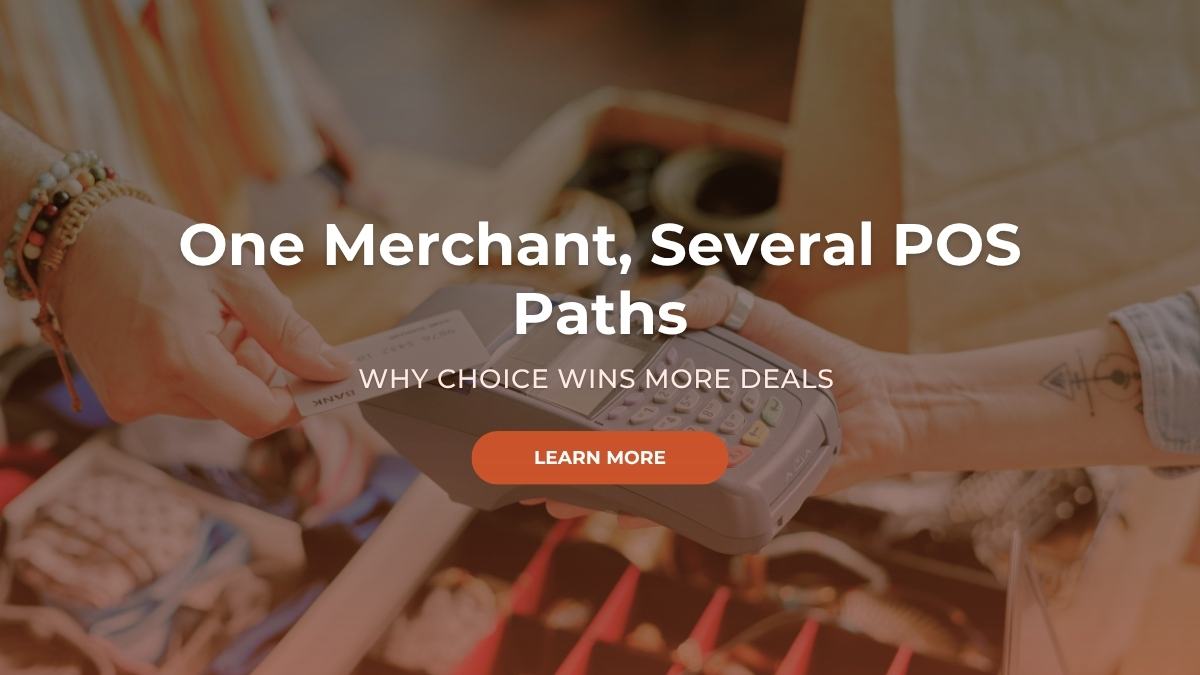
As a merchant services broker or independent sales organization, your focus is selling point-of-sale systems effectively in a competitive market.
If you want to close more deals, improve retention and grow residual income, the shift to make is from a single-product pitch to a multi-path consultancy model. Here is why choice wins.
Why Having One Track is Dangerous in POS Sales
When you approach a merchant with only one path to offer, you limit your closing rate before the conversation starts.
If the prospect falls outside your product’s ideal niche, it will not work, and they will sense it. Friction builds and the deal stalls. Worse, if you do close them on a system that does not fit their workflow, they will leave the moment a competitor offers something tailored — and a churned account pays you nothing forever.
The reverse is also true, and it is the part most agents underestimate: the path you cannot offer is the deal you do not get a second shot at. A merchant who names a system and hears “we don’t carry that” has already started looking elsewhere, and you will never know whether they were serious about it or just testing you.
REPAIR — the source draft’s paragraph here stopped mid-clause (“By contrast, positioning yourself as an objective advisor who provides a curated selection of”) and duplicated the sentence above it. Replaced with the lost-deal argument it was reaching for.
Positioning yourself as an objective advisor who carries a curated selection builds trust immediately, because it is the only position from which a recommendation means anything.
How to Tailor the POS Path
To use a multi-path strategy well, you have to be able to answer the questions and know which system to point at.
When you are pitching a business that values speed, minimalist design and an all-in-one software ecosystem, Square is usually the right path. Pop-up shops, boutique retail, mobile services, salons, coffee shops and microbreweries all sit comfortably here.
Square wins on simplicity. With Tap to Pay on iPhone and Android, a merchant can take contactless payments on the phone they already own, with no hardware at all — which turns “let me send a proposal” into “try it this weekend.” Invoicing, team management and loyalty sit under the same roof.
High-volume establishments with complex operational needs usually benefit more from Clover. Full-service restaurants, multi-location retail, medical spas and mid-market merchants are good examples.
Clover wins on customisation. Built on Android, it offers heavy-duty hardware paired with a large app marketplace. Whether a restaurant needs table mapping and kitchen display integration, or a retailer needs inventory across several warehouses, Clover can be tailored to it.
The two paths most agents forget
Square and Clover are the two every agent knows, which is exactly why leading with them in a full-service restaurant loses deals to the specialists. Two more are worth carrying:
- SkyTab for full-service restaurants and bars wanting tableside ordering, pay-at-table and delivery integration without the price tag of the name-brand restaurant platforms.
- OrderCounter for operators who want a restaurant system built around their workflow rather than a generic tablet — heavier configuration, higher ticket, stickier account.
For inventory-led retail, Korona POS handles the matrix, multi-store and stock-control problems that make a lightweight tablet system fall over around the eighteen-month mark.
The point is not to memorise five platforms. It is to have somewhere to go when a merchant describes an operation your default system cannot run. Two or three is usually enough; nine is a support liability dressed up as a portfolio.
Presenting Different Paths to Customers
When showing the value of choice, be concrete. The Square path means low upfront hardware cost because merchants can use devices they already own, flat and predictable pricing, and tight internal integrations. Processing is typically flat-rate.
The Clover path means more customisation and heavier hardware, which is why it suits higher-volume retail and full-service operations, and why it usually comes with a different pricing structure.
One detail worth using in the Square conversation: because Tap to Pay needs no hardware, a merchant can be taking cards before you have left the building. The trade-offs are real — it will not take chip-only cards and it will not work offline — and they are covered in Square Tap to Pay vs. the Square Card Reader. Know them before you pitch it.
How Choice Directly Wins More Deals
Offering multiple paths changes the psychology of the sale in three ways.
- You Remove the “No”
With a single option, the merchant’s decision is binary: yes or no. With several, the decision becomes which one works better for me? You have removed “no” from the immediate equation and replaced it with a comparison you are qualified to guide.
- You Can Show Them Different Hardware
Many merchants have already done their own research and have fixed ideas about hardware. If someone has their heart set on a particular form factor, forcing a handheld-only system will not close them. With diverse hardware — countertop terminals, mobile readers, full registers — you pivot to match rather than argue.
- You Protect Your Rates
High-volume merchants are highly sensitive to processing rates. With a multi-path portfolio, you can place smaller, simpler merchants on flat-rate systems and steer larger, high-volume merchants toward platforms that support interchange-plus. You stay competitive on rate without giving up margin across the whole book.
What Choice Does to Your Residual
There is a fourth benefit that does not show up in the closing rate, and it is the one that matters most over five years.
Residuals only pay while the merchant is still processing. A merchant on a system that genuinely fits their workflow stays. A merchant on the system you happened to carry starts looking the first time it fails them at a busy moment — and by then a competitor is already calling.
Multi-path selling is not really a closing tactic. It is a retention strategy that happens to close more deals. That is also why deployment matters so much: a well-matched system that is badly set up churns just as fast as a mismatched one. The three levels of involvement — refer, close, or close and deploy — pay differently for exactly this reason, and the third pays most because it produces accounts that survive. That is the model behind the Turnkey Square reseller program and the wider merchant services line-up behind it.
FAQ
Why shouldn’t I sell just one POS system?
Limiting yourself to one system forces you to pitch a rigid solution to businesses with distinct workflows. When a merchant’s operation does not match your product, you lose the deal, and they find someone else. Offering choice shifts you from vendor to consultant, which raises both trust and closing rate.
Is it difficult to learn and support multiple POS ecosystems?
No. Most leading platforms offer agent training portals, certification tracks and direct-to-merchant support. Your job is to understand operational fit, hardware capability and pricing structure — not to become a technical expert in five systems. Two or three platforms cover most of the market.
What if a merchant changes their mind about hardware after the sale?
This is where a multi-path model protects you. If a tablet setup is no longer enough for a growing business, you do not lose the account — you migrate them to the right path yourself instead of watching a competitor do it.
Doesn’t offering options confuse merchants?
Only if you offer all of them. Present two, with a clear recommendation and the reason for it. Choice paralysis comes from an unfiltered menu; confidence comes from a curated one with an opinion attached.
Who owns the merchant account if I place it on a different platform?
It should not change. In a well-structured programme, the merchant is coded to you for the life of the account regardless of which platform they sit on. Confirm this in the agreement before you place your first deal with any partner.
What happens to my residuals if I leave?
Programme-dependent, and worth reading closely. Some pay for the life of the account regardless of your production. Others stop the month you do.
Become a Master of the POS Paths
The secret to selling point-of-sale systems is not memorising your pitch; it is mastering discovery.
By diagnosing a merchant’s specific pain—long checkout lines, messy inventory, rigid software, a kitchen that never gets the ticket — and mapping it to the right path, you change what you are. When you give merchants the power of choice, you stop selling products and start delivering solutions. That is what brings people back, and what makes you the person they recommend.
If you would rather carry several paths than one, start the Square reseller application — Square plus six other platforms, no exclusivity, no minimums — or talk to our team first.
